

Government budget signals in sales: how to read a public budget before the RFP
Which government budget documents show real purchase intent, when to reach out, and how to qualify a budget signal before a rep works the account.

A public budget can tell you which government and education accounts are preparing to buy before an RFP appears. For example, if a school district has approved $400,000 for a new student information system, the project has moved beyond general need. Instead, actual money has been allocated for it.
This guide explains which government budget records reveal real purchase intent, when in the fiscal year to reach out, how to qualify a budget line before a rep works it, and how to monitor budget activity across an entire territory.
What are government budget signals in sales?
Government budget signals are public records showing that a state agency, city, county, school district, or university has proposed, approved, or finalized budgets. They tell a sales team which accounts can actually fund a purchase, months before any solicitation appears. A rep reading them knows whether the money exists before investing time in the account.
Budget documents that carry real purchase intent
- A proposed budget shows what a department requested.
- An adopted budget shows what the governing body actually funded.
- A capital improvement plan shows the projects a government has already scheduled and priced across several years.
Each document answers a different question about a purchase, and reading the wrong one is how reps end up working accounts with no money behind the project.
Proposed budgets versus adopted budgets
Sales reps need to remember that a proposed budget by an institution is not a commitment. It is a request.
The department head submits an estimate, the mayor, manager, or superintendent assembles those estimates into a recommended budget, and the council or board then decides what survives.
That distinction changes the outreach:
- For example, a $250,000 line for a permitting system in a city’s proposed budget tells a rep that a department wants the purchase and has put a number on it.
- The same line in the adopted budget tells the rep the council approved the spending.
The $250,000 entry in the budget is a reason to start a conversation. The $250,000 entry in the adopted budget is a reason to move the account to the top of the list.
Capital improvement plans and the annual operating budget
A capital improvement plan covers different funds than the annual operating budget.
- Operating budgets pay for recurring costs like salaries, licenses, and maintenance.
- Capital plans fund one-time investments in long-lasting assets.
Whitney Afonso of the UNC School of Government describes a capital improvement plan as a multi-year blueprint typically spanning five to ten years, built around investments with a useful life of more than five years.
Line item changes, fund balance shifts, and carryover
Year-over-year changes within a budget reveal more information than the budget totals. For example:
- A new line where none existed last year marks a project someone has decided to start.
- A line that doubled points to an expansion.
- A line that moved between departments usually means ownership of the problem changed hands, which also changes who a rep should call.
Fund balance and carryover work differently.
- Fund balance is money a government did not spend in prior years and still holds.
- Carryover is unspent money from the year just ended that a department is allowed to keep for the same purpose.
Both create purchasing capacity that does not appear as a new appropriation, and both tend to fund smaller, faster purchases that avoid a lengthy procurement process.
Timing outreach to the fiscal year budget calendar
The line item is written months before the governing body approves it. A rep who waits for the adopted budget is reading a decision that has already been made.
The purchasing sequence of a government buyer stays consistent even though the dates do not:
- A department head submits a funding request.
- The chief executive consolidates those requests into a proposed budget and files it with the council or board.
- The governing body holds hearings, adjusts the numbers, and adopts a final budget before the fiscal year starts.
- Money becomes available on the first day of the new year.
Forty-six states begin their fiscal year on July 1, with New York starting April 1, Texas September 1, and Alabama and Michigan October 1, according to the National Association of State Budget Officers. Most K-12 districts follow their state’s July 1 year. Higher education institutions vary, so a rep covering campuses has to check each one rather than assume a shared calendar.
In a July 1 jurisdiction, that places the request window in late winter and the hearing window in spring.
Budget line items usually appear in draft budgets six to twelve months before a related solicitation, which is the same window when pre-RFP opportunities surface.
Reps should be in the account while the department is still deciding what to ask for, then come back during hearings when the number is public and still changeable.
How do you qualify a budget signal before a rep works the account?
A budget signal is worth working by a rep when the budget is proposed and/or adopted, tied to a named program or project rather than a departmental total, and large enough to cover the purchase.
A line that fails any of those tests belongs on a watch list, not in a rep’s queue.
What budget cuts and freezes tell a rep
A cut or hiring freeze in your buyer’s department is a real signal, and reps should treat it as one.
Deprioritize the account and set a reminder for the next budget cycle. The exception is a cut that explicitly names your category as what’s being replaced, which usually means a vendor is on the way out.
Monitoring budget activity across a full territory
Reading budget documents account by account works for a handful of accounts, but collapses at territory scale. Every entity publishes on its own calendar, in its own format, on its own website.
- A county may post a searchable PDF in May.
- A district may post a 200-page board packet the night before the vote.
- A university may post nothing public at all until the trustees approve the budget.
If you want to automate the manual lead research process, consider Starbridge.
Starbridge is the AI GTM platform for companies selling to the government, K-12, and higher education, helping teams prioritize the right accounts, engage the right people earlier, and identify high-intent opportunities before the competition.
The Buying Signal Monitor watches budget documents alongside board meeting minutes, grant awards, and contract expirations across 320k+ entities, then delivers the account, the specific budget line that triggered the alert, and who to call about it.
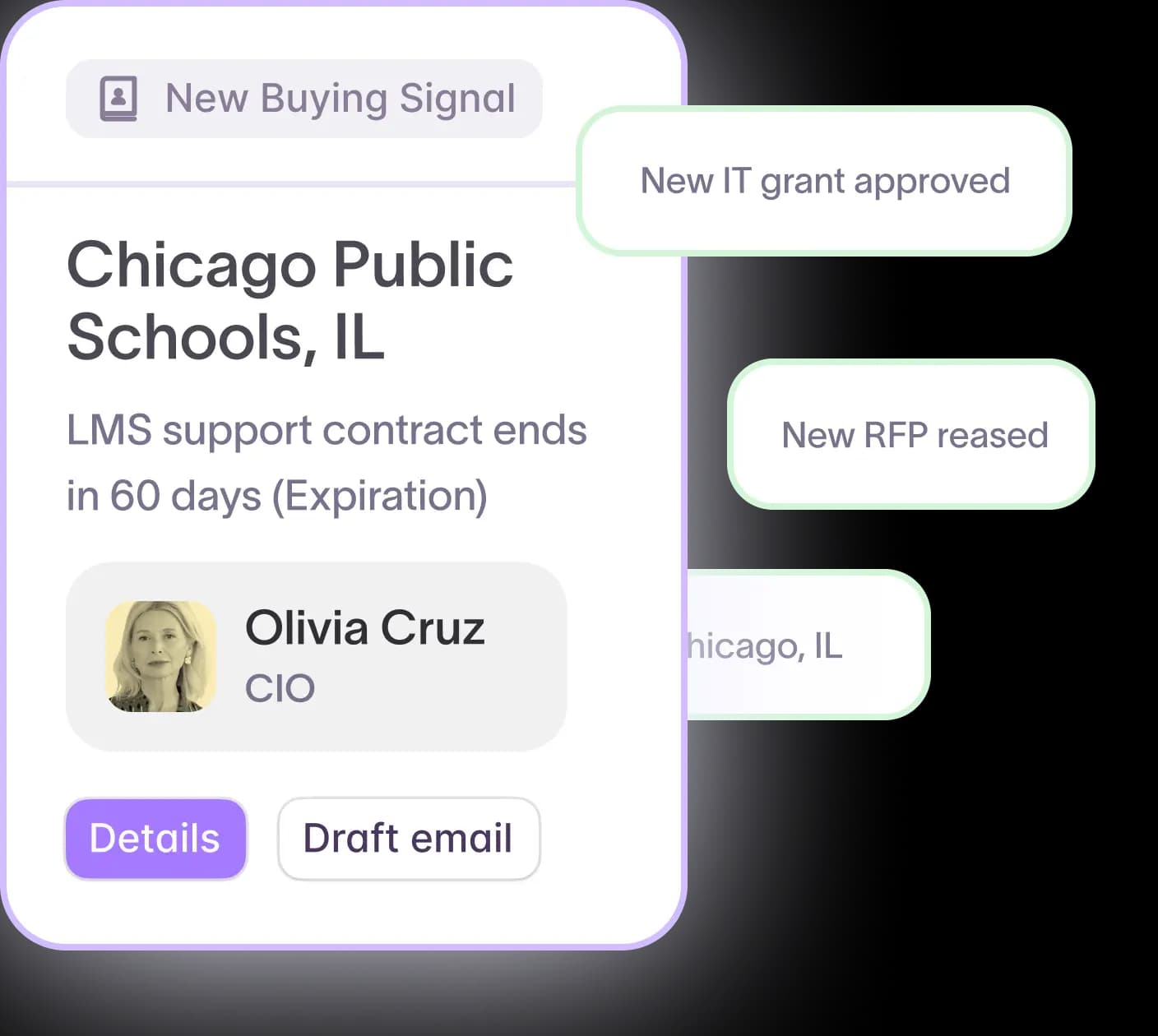
InquirED drove $200K in new pipeline in their first quarter with Starbridge, replacing manual board-document research with signal-driven account scoring that revealed which districts were actually ready to buy.
Turn budget records into a ranked territory
Budget documents are the most direct evidence a government or education buyer can give you that a purchase is coming.
They are also the type of evidence most sales teams skip, because reading them takes work and the payoff only appears after you compare this year’s lines to last year’s.
Using budget signals inside an account score
A budget signal does not rank an account on its own. It ranks that account against the others in the territory.
Use the funded status, whether the line names a project, and the size fit, then combine that with account fit and any other government buying indicators.
A district with an adopted, named, correctly sized line and a recent board discussion outranks a district with a bigger budget and nothing specific in it.
Start narrow: Identify the twenty accounts in your territory that matter most, pull their adopted budgets and capital plans, and mark every line that touches your category.
That first pass usually retires a few accounts your team has worked on for months and promotes a few nobody has called.
Then decide whether your team can continue reading budgets by hand across the entire territory.
Want to see which accounts already have a budget assigned to your category, in your entire TAM? Book a demo and we will show you how Starbridge surfaces funded buyers and helps your reps win more deals.
Frequently asked questions
A proposed budget is the spending plan a mayor, manager, or superintendent recommends to the governing body. An adopted budget is what the council or board actually approved. A line in the proposed budget shows intent. The same line in the adopted budget shows funding.
Most entities post budgets on the finance or budget page of their own website, and districts often attach them to the board agenda packet for the adoption meeting. State budget offices publish proposed and enacted state budgets. Otherwise, contact the clerk’s office.
A capital improvement plan is a multi-year schedule of one-time investments in long-lived assets, typically covering five to ten years. Its first year feeds the annual capital budget, so a project moving into year one has actual funding attached. Projects further out are watch items.
Not always. An RFP is triggered when the price exceeds the buyer’s sole-source threshold, and thresholds range from $5,000 to $150,000 by state, municipality, or district. Below the threshold, or through a cooperative contract, a funded buyer can issue a purchase order without an RFP.
Commercial intent data infers interest from behavior like content downloads and site visits. Government budget signals are official records of money a public body requested or approved. One suggests a buyer might be looking. The other confirms the buyer has funding.
Explore our use case library
 Automate account research with AI agentsStop manually researching accounts. Starbridge AI agents automate account research by monitoring buying signals 24/7 and surfacing the right contacts.
 Identify competitor contract expiration datesThe RFP is usually a formality. Starbridge surfaces competitor contract expiration dates so your reps reach accounts before the renewal cycle closes.
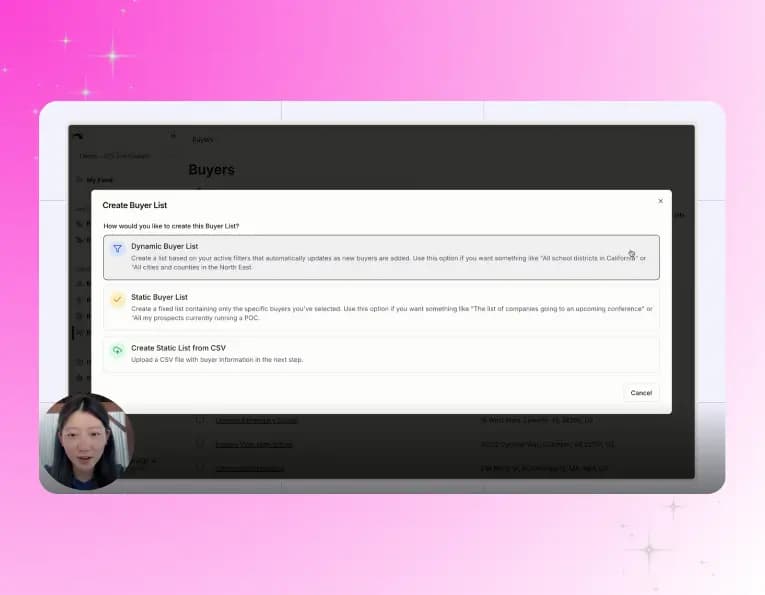 Create a conference campaignTurn conference badge scans into pipeline. Import your contact list, surface buying signals across every account you met, and follow up with context.
