

4 GovSpend alternatives for government and education sales intelligence in 2026
Need more than purchase order data? Compare four GovSpend alternatives for government and education sales teams across the five capabilities that build consistent pipeline.

Government and education sales teams searching for GovSpend alternatives typically want more than historical purchase order data. They need a platform that helps them identify opportunities before the RFP, reach the right decision-makers with accurate contact data, and move from buying signal to closed deal without reaching for multiple tools.
This article evaluates four platforms across five non-negotiable capabilities for government and education sales teams. The comparison table below provides a quick overview, with detailed breakdowns for each tool in the sections that follow.
| Platform | Identifying opportunities before RFPs | Contact and account data quality | Visibility into agency spend | Finding and responding to RFPs | Contract vehicle access |
|---|---|---|---|---|---|
| Starbridge | Monitors hundreds of thousands of entities for board minutes, budgets, grants, leadership changes, contract expirations | Proprietary web-agent technology crawling .gov/.edu domains, 98% email accuracy | FOIA automation at scale, vendor proposals, opt-out clauses, and expiration dates | AI-scored RFP feed across thousands of bid portals with native proposal writer | Shorten sales cycles by selling through NASPO, OMNIA, Sourcewell and more with pre-approved access |
| ZoomInfo | Commercial B2B web intent signals from IP-to-org pairings and publisher networks | Millions of professional profiles partly sourced from LinkedIn and business card data | Firmographic and technographic data for commercial accounts | Commercial intent signals; RFP workflow centers on general sales engagement tools | Contract vehicle access is not part of the offering as of July 2026. |
| GovWin (Deltek) | Hundreds of analysts surfacing federal leads years before RFP, newer state and local coverage | Contact data sourced from procurement listings and agency org charts | Spending, strongest at federal level | Strong federal bid aggregation with hundreds of thousands state and local agencies | Contract vehicle access is not part of the offering as of July 2026. |
| MDR (Dun & Bradstreet) | Education marketing data and campaign services; buying signals come from educator engagement data rather than procurement monitoring | Millions of educator contacts across thousands of institutions with role-based segments | Focused on educator audience data rather than procurement spend or contract intelligence | Traditionally for marketing campaign execution rather than bid discovery and proposal response | Contract vehicle access is not part of the offering as of July 2026. |
The non-negotiable capabilities in a government and education sales intelligence tool
Building consistent pipeline in local government, K-12, and higher education requires five capabilities working in concert:
- Pre-RFP opportunity identification. Board meetings, budget releases, grants, leadership changes, and contract expirations are all buying indicators that show up months before an official solicitation makes the rounds. Teams that can surface these signals early have a structural advantage, because by the time an RFP drops, an incumbent vendor or a faster-moving competitor has often already influenced the conversation.
- Quality contact and account data. Decision-makers in state and local government, K-12, and higher education rarely maintain LinkedIn profiles, which means platforms that rely on LinkedIn scraping experience 15-25% bounce rates. Wasted rep time, lower deliverability scores, and reduced sequence performance compound quickly when a quarter of your emails never land.
- Visibility into current agency and institutional spending. Insight into the incumbent vendor, contract value, and expiration date before a discovery call changes the entire conversation. Spend intelligence turns cold outreach into informed displacement plays and gives reps the context to position against a specific competitor.
- Finding and responding to RFPs effortlessly. Government and education procurement runs through thousands of bid portals across state, local, and district-level agencies, and winning starts before the RFP drops. A centralized, scored RFP feed paired with AI-assisted proposal drafting lets teams find the right opportunities faster and respond without burning hours on manual formatting and compliance checks.
- Contract vehicle access that removes procurement friction. Above a buyer’s sole-source threshold, a deal either routes through an existing cooperative contract or triggers a full competitive solicitation that can add months. Vendors who can transact through vehicles like NASPO ValuePoint, OMNIA, Sourcewell, or TIPS give procurement offices a faster path to purchase. Teams without vehicle access watch won opportunities stall in procurement.
All five capabilities need to work together holistically. A tool that covers only a couple of these areas leaves the door open for manual work, tool stitching, data reconciliation, and lost speed at every handoff. The strongest results come from platforms that connect buying signals to verified contacts, and from outreach to proposal execution, in a single workflow.
1. Starbridge

Starbridge is an AI sales intelligence platform created especially for state and local government, K-12, and higher education. More than 500 GTM teams use Starbridge to move from buying signal to closed deal in a single workflow.
What Starbridge does well
Starbridge’s Buying Signal Monitor tracks more than 320,000 government and education entities around the clock, surfacing buying indicators from board meeting minutes, budget data, grants, leadership changes, contract expirations, strategic plans, and bids. A vector database handles context rather than relying on keyword matching, and much of this meeting intelligence comes from YouTube recordings of council meetings and school board hearings that general-purpose AI tools cannot index.
Every buying signal fires with a verified contact, a reason for outreach, and AI-generated personalized copy pushed directly to Salesforce, HubSpot, Apollo, or Outreach. GovWell, for example, booked five meetings from Starbridge buying signals in their first week on the platform and now sources 15% of total qualified pipeline through it.
Reaching those accounts requires contacts that general-purpose databases consistently fail to provide. Contacts & Company Data is built on proprietary web-agent technology that continuously crawls .gov and .edu domains, agency directories, school district portals, and board minutes rather than scraping LinkedIn profiles.

Waterfall enrichment and continuous bounce checking achieve 98% email accuracy, validated in a 14,000-email test, with a 2% bounce rate compared to the 15-25% industry standard for general-purpose databases. AI-powered account prioritization, champion tracking, and bi-directional CRM integrations that sync, clean, and enrich data natively in Salesforce and HubSpot complete the picture.
Context matters before any discovery call, and teams often go in without enough of it. Public Spend Intelligence uses FOIA automation at scale to surface full competitor contracts, unredacted vendor proposals, opt-out clauses, and expiration dates.
Out of the box, Starbridge has purchase order data covering 77% of local government, K-12, and higher education institutions. Spend records cross-reference against the buying signal dataset, so reps can see not just what an agency bought last year but whether that contract is expiring and who the decision-maker is today. Zencity’s enterprise team now sources 50% of cold meetings through Starbridge, with reps pulling city priorities from recent council meetings in seconds before outreach

For teams that do respond to formal bids, the AI RFP Finder & Proposal Writer pulls thousands of bid portals into a single scored feed, ranks each opportunity by product fit, region, and win likelihood, and flags any RFP that names a competitor. The proposal writer drafts responses using the team’s own product knowledge base, and a built-in compliance matrix keeps teams on requirement without toggling between documents.
From buying signal to signed contract, Starbridge also clears the procurement roadblock that stalls deals after a buyer says yes. Starbridge gives you a faster path to purchase by providing access to every major contract vehicle including NASPO ValuePoint, OMNIA Partners, Sourcewell, TIPS, and GSA. Starbridge handles the compliance, paperwork, and renewals. Because the platform already knows each buyer’s preferred purchasing channel, reps can route every opportunity down the fastest compliant path to a signed PO.
Where Starbridge falls short
Teams selling primarily into federal agencies will find deeper coverage from federal-focused platforms. Starbridge’s strength is state and local government, K-12, and higher education, and its federal coverage is not as deep.
The RFP writer is lightweight and truly helpful in accelerating manual processes, but it doesn’t completely replace an RFP hire. Companies managing high-volume, complex federal proposals should expect to use Starbridge’s RFP tools as a drafting assistant, not a full substitute.
Starbridge is also better suited to enterprise sales teams than to early-stage companies due to its premium pricing. The 98% email accuracy and purpose-built government and education data come at a higher price point than general-purpose alternatives.
Best for
Revenue teams running outbound into state and local government, K-12, and higher education who need one platform from buying indicator to closed deal, with verified contacts, competitive context, and built-in CRM workflows.
2. GovWin (Deltek)

GovWin is a market intelligence platform owned by Deltek, backed by more than 150 industry analysts who collectively handle thousands of research requests annually. Traditionally for federal government contractors, GovWin has expanded more recently into state and local government and education coverage.
What GovWin does well
GovWin’s defining strength is its analyst-driven federal opportunity intelligence. A team of analysts tracks federal procurement pipelines, recompete timelines, and agency spending patterns, surfacing leads years before an RFP appears on SAM.gov. For federal contractors, this analyst layer provides insights into agency priorities, program funding trajectories, and competitive landscapes for specific contract vehicles.
GovWin maintains a comprehensive bid aggregation database. Contract awards, spending analysis, and solicitation tracking give teams a centralized view of government procurement activity.
For federal pursuits specifically, GovWin offers pricing and competitive intelligence, including labor rate analysis, competitor identification, and teaming partner recommendations. The Ask Dela AI feature provides document summarization capabilities that help teams digest lengthy solicitations and agency reports. These tools are created with the federal contracting workflow in mind, where pricing competitiveness and teaming strategy often determine whether a bid advances.
Where GovWin falls short
GovWin’s state and local government and education coverage is a more recent addition to a platform that was architected for federal procurement. One G2 reviewer noted that "searching outside of my saved searches is challenging. The filters are not user-friendly and can be difficult to find what I'm looking for. Lately postings have been missing attachments or have wrong dates." Teams selling primarily into state and local government and K-12 may find that the depth and accuracy of coverage doesn’t match what the platform delivers on the federal side.
GovWin’s search model can generate a high volume of results that require manual filtering and review. The platform is known for research and opportunity tracking rather than proactive pipeline building, which means those using GovWin for state and local government sales may spend significant time sifting through results to find the opportunities that actually match their product and region.
The platform integrates natively with Deltek’s own CRM products (Costpoint, Vantagepoint), and teams using Salesforce or HubSpot should evaluate the depth of available integrations to ensure the platform fits their existing workflow.
GovWin tracks contract vehicles closely, reporting on GWACs, IDIQs, and recompetes as part of its market intelligence. Tracking a vehicle is not the same as selling through one, and getting a vendor onto a vehicle like NASPO ValuePoint or Sourcewell is not a capability the platform offers as of July 2026.
Best for
Federal contractors who need analyst-backed opportunity intelligence, recompete tracking, and pricing analysis, and who also want some visibility into state and local government solicitations from the same platform.
3. MDR (Dun & Bradstreet)

MDR Education is the education data division of Dun & Bradstreet, with more than 50 years of education market expertise. The company offers data through its ConnectED Cloud platform and operates as a full-service education marketing agency. MDR’s basis is education marketing data and campaign services rather than purely sales intelligence.
What MDR does well
MDR maintains one of the deepest K-12 educator contact databases on the market, with millions of verified contacts spanning thousands of institutions and hundreds of role-based segments. This data is proprietary, not scraped from third-party sources, and is continuously updated during the school year.
MDR operates as a full-service education marketing agency with strategy, brand development, demand generation, and experiential programs. Many staff members are former educators, which gives the agency a practitioner’s understanding of how schools and districts evaluate and adopt products. Services include paid social, digital advertising, email marketing, direct mail, influencer partnerships, and educator focus groups that help edtech companies understand their audience before launching campaigns.
The We Are Teachers media brand gives MDR a direct channel to educators that few competitors can replicate. With millions of monthly pageviews and social followers, We Are Teachers offers sponsored content, the Teacher Picks product review program, and educator-facing content that builds brand awareness within the K-12 community.
Where MDR falls short
MDR’s strengths center on educator audience targeting and campaign execution. Teams that need buying indicators, procurement intelligence, or early demand signals that an agency is about to purchase in their product category would need to supplement it with a separate source.
The platform’s coverage is focused on K-12 and, to a lesser extent, higher education. State and local government entities such as cities, counties, and state agencies fall outside its primary coverage area. If you’re selling to both education and government, you’d need a separate data source for the government side of the market, which adds cost and complexity to the GTM stack.
MDR consolidates its updates into a comprehensive batch refresh every two weeks during the school year. That cycle means a staffing change can sit for up to fifteen days before the next refresh catches it, which matters most for districts with active hiring or turnover.
Marketing reach gets a product in front of educators. The purchase itself often runs through a cooperative purchasing vehicle like TIPS, BuyBoard, or Sourcewell that lets a district buy without running a full solicitation. Access to those vehicles is not part of MDR’s offering as of July 2026.
Best for
Edtech companies whose primary motion is marketing to K-12 educators and who need a large, verified educator contact list paired with agency services to run campaigns through the education buying cycle.
4. ZoomInfo

ZoomInfo is a B2B intelligence platform for commercial sales teams. It maintains one of the largest general-purpose contact databases and tracks web browsing patterns, aggregates professional networking data, and captures intent signals from publisher networks through IP-to-organization pairings.
What ZoomInfo does well
ZoomInfo’s core strength is the scale of its B2B contact database and intent signal infrastructure. With millions of professional profiles and IP-to-organization pairings, the platform gives commercial sales teams broad visibility into who is researching their product category. Intent signals are sourced from publisher networks that track B2B content consumption, helping teams prioritize accounts showing active commercial buying interest.
ZoomInfo has invested heavily in sales workflow automation through ZoomInfo Engage, Chorus for conversation intelligence, and native sequencing tools. These features let teams move from contact discovery to multi-step outreach without leaving the platform. CRM integrations with Salesforce, HubSpot, and other major platforms keep data synchronized, and the engagement layer supports multi-contact tracking across teams.
Technographic and firmographic data provide commercial sales teams with a detailed picture of target accounts, including tech stacks, org charts, revenue figures, and company hierarchies.
Where ZoomInfo falls short
The contact side carries a related structural challenge. ZoomInfo’s contact database draws heavily from professional networking profiles, contributed business card data, and commercial web sources, and platforms built on commercial data have a hard time keeping government and education contact data fresh.
Decision-makers in local government, K–12, and higher education rarely maintain LinkedIn profiles, which means the contacts that matter most for government and education outreach are the least likely to appear in a LinkedIn-derived database.
ZoomInfo’s intent signals are based on commercial web-browsing behavior, tracking which companies consume B2B content across publisher networks. Government and education buying intent tends to surface through board meeting minutes, budget releases, grant awards, and contract expirations rather than commercial web browsing, which means teams selling into government and education may find that the buying indicators most relevant to their market are not present in the platform’s intent data.
Commercial B2B deals close on a signature. Government and education deals above a sole-source threshold usually need a contract mechanism too, often a cooperative purchasing vehicle like NASPO ValuePoint, OMNIA Partners, or Sourcewell. ZoomInfo is built for the commercial motion, and contract vehicle access is not part of the offering as of July 2026.
Best for
Commercial B2B sales teams selling to private-sector companies across multiple verticals who need a broad contact database with intent signals and workflow automation for the commercial web.
Which GovSpend alternative is right for you?
If your team sells primarily to federal agencies and needs analyst-backed intelligence on recompetes, pricing, teaming partners, and long-cycle federal opportunity tracking, GovWin gives you a research depth that is difficult to replicate. Federal contractors will find the analyst network and competitive intelligence tools valuable for that specific market.
If your team sells edtech products and needs a deep K-12 educator contact database with full-service marketing agency support, MDR offers a combination of proprietary education data and managed campaign execution that is designed for the education marketing motion.
If your team needs a large general-purpose B2B contact database with intent signals and workflow automation for commercial sales across multiple verticals, ZoomInfo is the strongest fit. Its scale and integration ecosystem are made for horizontal B2B motions where broad contact coverage matters more than market-specific depth.
If your team sells technology or services to local government, K-12, and higher education, Starbridge covers the full motion. The Buying Signal Monitor surfaces opportunities months before the RFP, Contacts & Company Data delivers 98% accurate contacts, Public Spend Intelligence provides competitive contract context, and the AI RFP Finder & Proposal Writer scores and drafts responses. It also hands buyers a purchasing pathway they already trust, with pre-approved access to every major contract vehicle.
Book a demo to learn how Starbridge helps your team win more deals in government and education.
Frequently asked questions
Explore our use case library
 Automate account research with AI agentsStop manually researching accounts. Starbridge AI agents automate account research by monitoring buying signals 24/7 and surfacing the right contacts.
 Identify competitor contract expiration datesThe RFP is usually a formality. Starbridge surfaces competitor contract expiration dates so your reps reach accounts before the renewal cycle closes.
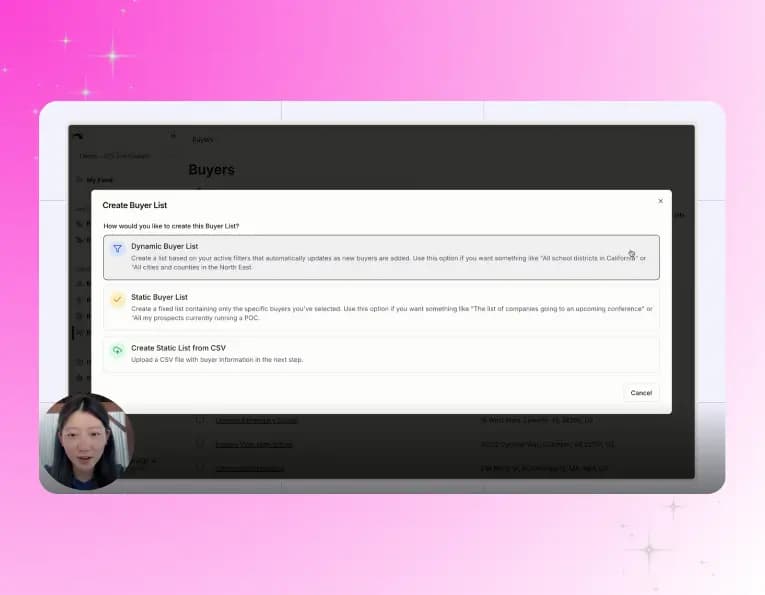 Create a conference campaignTurn conference badge scans into pipeline. Import your contact list, surface buying signals across every account you met, and follow up with context.
